Architecture Remembers what Power wants us to Forget
Two years since the world began live-streaming the genocide in Gaza, and more than a century into Palestinian dispossession, space has made power legible. Streets, checkpoints, borders, rubble: a cartography that tells us who is allowed to live, move, and remember. In Gaza, architecture has been both weapon and witness: homes targeted, hospitals besieged, water lines severed, schools flattened. Not by accident, but by policy.[1][2] This is a history of erasure and endurance, of architecture turned to rubble, and rubble turned to resistance. To design in such a world is to confront how space itself is politicized: who gets to dwell? Who gets displaced? Who or what gets rebuilt?
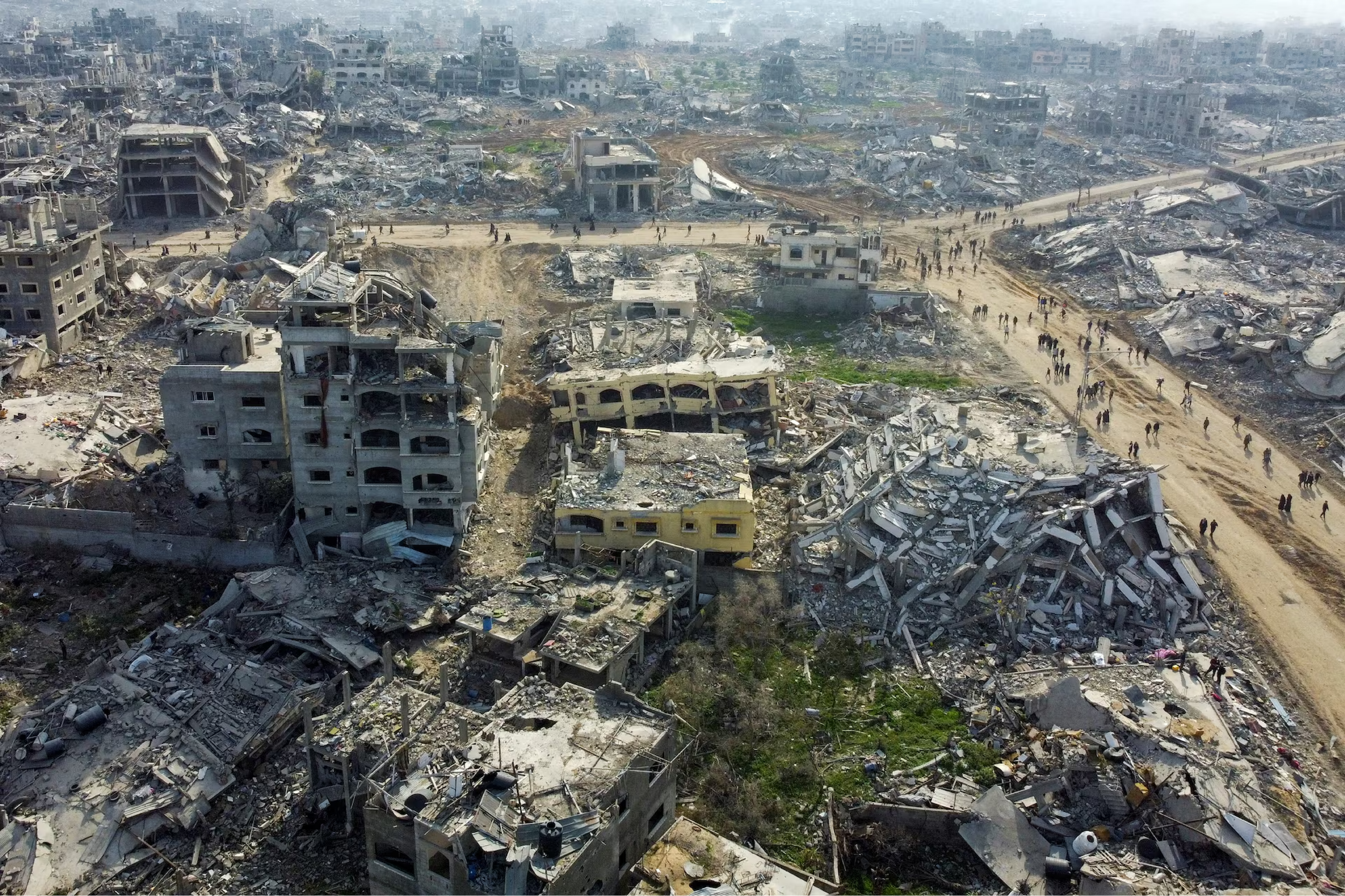
A drone view shows displaced Palestinians walking past the rubble as they attempt to return to their homes, amid a ceasefire between Israel and Hamas, in the northern Gaza Strip, January 19. REUTERS/Mahmoud Al-Basos
The violence is architectural. Infrastructure is targeted precisely because it sustains collective survival. This is what urban scholars call urbicide, the systematic unmaking of the city as a life-support system. Forensic investigations map patterns of intimidation and strikes on medical infrastructure. They show how ‘evacuation corridors’ and ‘safe zones’ have been instrumentalized inside military operations.[3][4][5][6] When health systems and schools are turned into targets, what falls is not just buildings; it is the collective capacities that hold a people in life. The violence is also ecological. Independent and UN assessments document mass destruction of orchards and green cover, contamination of soil and water, and devastation of agriculture. This is an unhousing of future harvests and a slow violence against return and self-sufficiency.[7][8][9][10]
Even where siege loosens, logistics, checkpoints, and spectacle (airdrops) replace reliable corridors for food, medicine, and fuel. Forensic Architecture describes a “military model” of aid: visibility without sufficiency.[11] The UN reports continue to record catastrophic hunger and lethal barriers to delivery, coupled with choke points at crossings such as Rafah. In this context, design – routes to clinics, kitchens that feed neighbours, courtyards that hold grief, ruins that shelter resistance – becomes survival infrastructure.
Silence isn’t safety, it’s alignment.
Language and design are the twin infrastructures of legitimacy: when we call siege a “conflict,” demolition a “clash,” we launder violence. Words draft blueprints which in turn become facts on the ground. Naming matters: language either exposes power or excuses it. After being detained during a Gaza aid flotilla and later deported, Greta Thunberg addressed press and supporters, explicitly redirecting attention from her mistreatment in Israeli custody to Gaza’s humanitarian catastrophe. Why include this here? Because witness is spatial. The interception of flotillas in international waters, the detention of hundreds of activists, and the controversies around ‘lawful’ blockades are all spatial claims: who can move aid, who can cross a sea, who controls corridors and ports. Thunberg’s message, do not centre me, centre the siege, is an ethical orientation designers must learn. We must place attention where harm is organized. We must understand implicitly how our discipline can either obstruct or enable the flow of life.
My first course in Cultural History as an undergraduate architecture student was on the Holocaust: a searing lesson that architecture is fully capable of serving atrocity. Camps were designed – sites selected, barracks standardized, circulation diagrammed – by professionals who drew, costed, coordinated, and built within a murderous bureaucracy.[12][13][14] Hannah Arendt called it the “banality of evil,” ordinary careers proceeding through extraordinary violence.[15] That course made one thing unambiguous: our drawings and specifications are never innocent. They either materialize dignity or systematize harm. The history of the 20th century shows how procurement, logistics, labour, zoning, and typology can be conscripted into authoritarian projects; the 21st is a reminder that humanitarian language and ‘security’ design can do the same.[16] The ethical horizon of our profession is human life: its protection, flourishing, and memory.
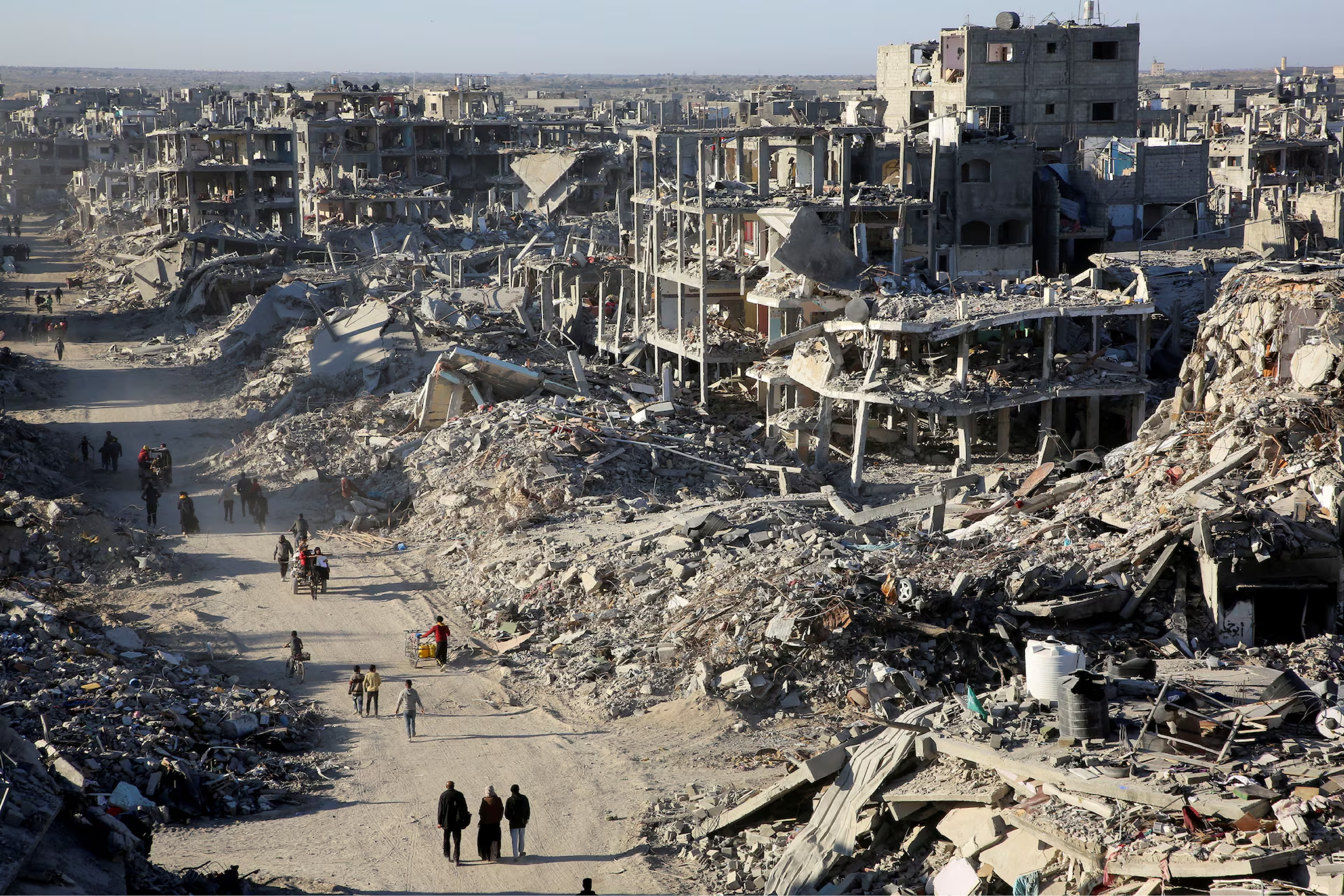
Palestinians walk past the rubble of houses and buildings destroyed during the war, following a ceasefire between Israel and Hamas, in Rafah in the southern Gaza Strip, January 20. REUTERS/Hatem Khaled
Yesterday’s (October 8, 2025) headlines speak of a breakthrough: negotiators say the first phase of a ceasefire has been agreed in principle. But the architecture of the deal, as described in Trump’s 20-point plan and subsequent analyses, keeps Gaza’s future under external administration and staggers core political questions into a hazy later stage. This is what we mean by colonial terms: security first, sovereignty deferred; international management without self-determination; ‘order’ prioritized over return, rights, and repair. If the profession treats construction as merely technical, if we rush to pour concrete while the terms of life remain externally controlled, we will be the mechanism that codifies injustice into place.
Our field must unlearn neutrality. Our discipline must unlearn its false innocence. Urbanism cannot be apolitical. Sustainability cannot be sanitized. Safety cannot be built for some while it is denied to others. Eyal Weizman shows how settlements, surveillance, and road networks are instruments of domination, not scenery.[17] Noura Erakat traces how international law has been leveraged to normalize dispossession even as it remains a terrain of struggle.[18] Rashid Khalidi situates the present within a century of settler-colonial war.[19] Together, they remind us that space is a strategy, and so must be our design.
So, what is our responsibility now?
I write this as an ally. We do not carry the lived experience of occupation, siege, and repeated displacement. Any agenda named here is incomplete without those who live its consequences, and it is legitimate only when designed, governed, and owned by Palestinians. Our role is to listen first, move at the speed of community consent, redistribute resources and decision-making, and step back when asked.
A Professional Agenda: so the ceasefire does not become a blueprint for control
No build without rights. Tie any design/rebuild engagement to explicit, public conditions: end of siege practices; freedom of movement; binding pathways to Palestinian governance and land tenure; enforceable protections for housing, health, and education.
Palestinian-led planning. Center Palestinian civil society, municipalities, professional institutes, women’s groups, and unions in decision-making authority, not just ‘consultation.’ Co-governance boards must be local-majority and transparent.
Anti-normalization in procurement. Refuse tenders and partnerships that entrench segregation or collective punishment (i.e. model villages, surveillance corridors, safe zones that displace). Create a red-lines registry the field can adopt.
Right-of-return design. Map claims, kinship, and damage truthfully (with forensic/legal teams) and prototype incremental rebuild typologies that restore household agency.
Life-support urbanism, now. Move early funds to canopy, water, shade, clinics, kitchens, non-mechanical cooling, decentralized energy – infrastructure that saves lives before walls go up.
Reparative ecologies. Seed banks, nurseries, orchard restoration, soil/water remediation. Re-planting is both food security and a claim on future time.
Memory as building material. Protect ruins and names; embed archives, testimony spaces, and public rituals into plans, so rebuilding cannot erase the record of harm.
Humility, consent, and accountability. Commit publicly to Palestinian leadership at every stage (briefs, budgets, design authority, authorship). Use consent-based methods (not extractive ‘consultation’), ensure fair pay and credit, protect data sovereignty, publish accountability reports, and withdraw from work that violates community-set redlines.
Safety is collective, or it is counterfeit. The question is never “is design political?” but “which politics does this design advance?”
At Lemon Papaya, our practice is collaborative design for collective liberation. We co-create spaces of care that help people survive now and build futures worth returning to. If you’re ready to align design with justice, let’s chat.
—
[1] The Guardian. “The Ruin of Gaza: How Israel’s Two-Year Assault Has Devastated the Territory.” October 7, 2025.
[2] Reuters. “Gaza War: Tens of Thousands Killed and Widespread Destruction.” October 7, 2025.
[3] Forensic Architecture. “Humanitarian Violence in Gaza.” March 14, 2024.
[4] Forensic Architecture. Inhumane Zones: An Assessment of Israel’s Actions. May 19, 2024.
[5] Al Jazeera. “Gaza’s ‘safe zones’ led to displacement, Israeli attacks on civilians: Report.” March 13, 2024.
[6] Forensic Architecture. “A Cartography of Genocide.” October 25, 2024.
[7] Yale Environment 360. “Up to 98 Percent of Cropland in Gaza Destroyed.” June 6, 2025.
[8] Food and Agriculture Organization. “Gaza’s Agricultural Infrastructure Continues to Deteriorate at an Alarming Rate.” May 26, 2025.
[9] H. Yin et al. “Evaluating War-Induced Damage to Agricultural Land in the Gaza Strip.” Heliyon Sustainability (2025).
[10] Forensic Architecture. “Ecocide in Gaza 2023-2024.” March 29, 2024.
[11] Forensic Architecture. “The Architecture of Genocidal Starvation.” August 1, 2025.
[12] Paul B. Jaskot. The Architecture of Oppression: The SS, Forced Labour, and the Nazi War Economy. London: Routledge, 2000.
[13] Robert Jan van Pelt. The Case for Auschwitz: Evidence from the Irving Trial. Bloomington: Indiana University Press, 2002.
[14] Jean-Louis Cohen. Architecture in Uniform: Designing and Building for the Second World War. Montreal: Canadian Centre for Architecture; Paris: Hazan, 2011.
[15] Hannah Arendt. Eichmann in Jerusalem: A Report on the Banality of Evil. New York: Viking, 1963.
[16] Cohen, Architecture in Uniform, 2011.
[17] Eyal Weizman. Hollow Land: Israel’s Architecture of Occupation. London: Verso, 2007, updated ed. 2023.
[18] Noura Erakat. Justice for Some: Law and the Question of Palestine. Stanford, CA: Stanford University Press, 2019.
[19] Rashid Khalidi. The Hundred Years’ War on Palestine. New York: Metropolitan Books, 2020.