ComFORT Downtown: On blanket forts, hot chocolate, and the architecture of intimacy.
Peter Kageyama writes that the things we love about cities are small, intimate, personal. And that play is essential to making places not just liveable, but loveable. In November 2012, we took him at his word.
ComFORT began as a response to his $500 Challenge, a dare to create a tiny invention with oversized heart. Our wager was simple: if a child’s fort is an early act of building, a first attempt at belonging, then perhaps a city could remember how to belong to itself by building forts together.
We sourced a kit: refurbished furniture, blankets, sheets, hot chocolate, and a sign that read “build your fort; build your city.” We found five corners of downtown Edmonton in the kind of cold that sharpens breath into speech bubbles. We laid out the materials like a picnic for civic imagination. There was no grand stage, no podium. Just an invitation, a pile of parts, a promise of warmth.
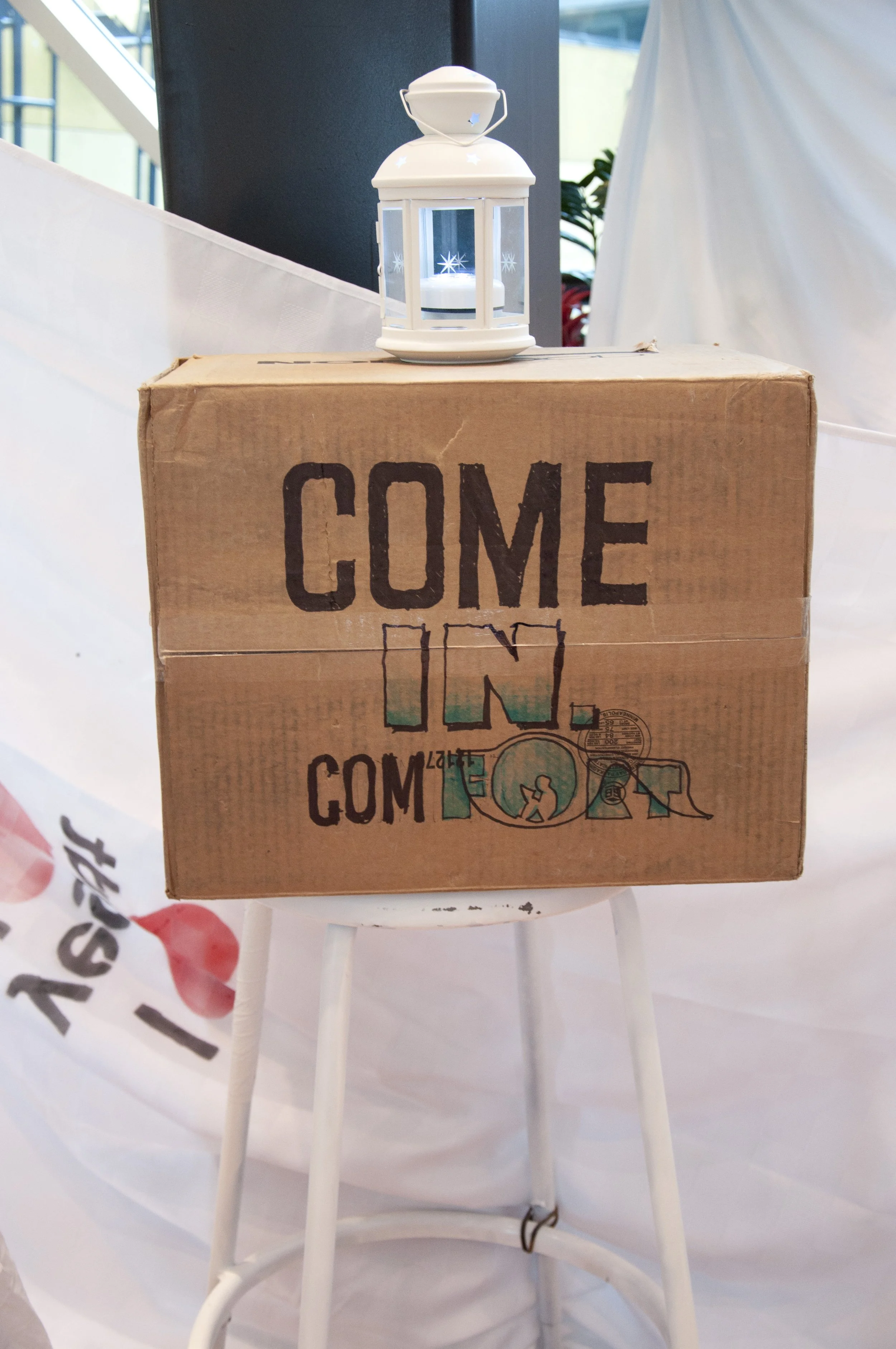
At first, people hovered. Edmonton knows winter; it also knows the choreography of getting through it: heads down, strides quick, errands efficient. But forts bend the rules. A little girl tugged her dad’s hand and asked if they could try. A student paused, then reappeared with three friends and mischievous grins. Strangers became teammates. Passersby became designers. ComFORT wasn’t a static installation, it was a verb.
We served hot chocolate (courtesy of Good Earth Cafe). People would wrap their fingers around the cups and share their stories: about the blanket forts they’d build as kids, about the alleys where they used to play, about the winters that felt both endless and somehow formative. Memory warmed faces better than any space heater.
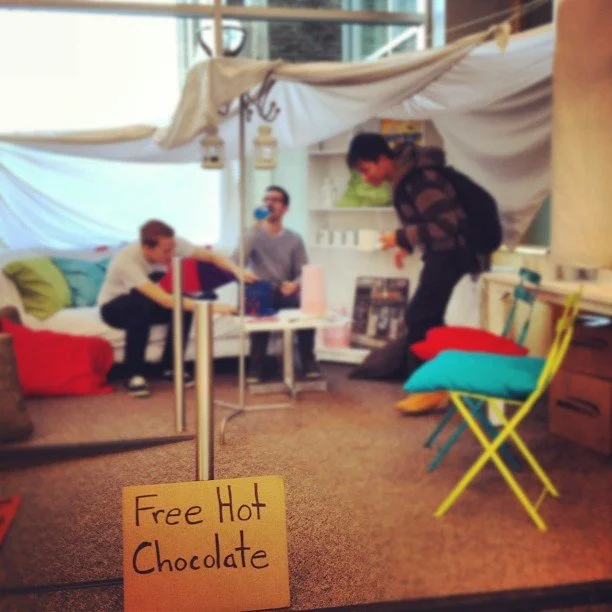
The best architecture we witnessed that month wasn’t made of fabric or furniture. It was made of conversation. The most durable structure was not the fort but the way people leaned toward one another, asking, “what if we try it like this?” Time and again, we saw the same pattern: it took one or two enthusiastic people to start, and then the energy multiplied. It didn’t take a crowd to change the mood of a corner, it took a spark.
We were asked often about the cold. Wouldn’t people scurry by? Wouldn’t they avoid the open air, the open ask? And yes, this was true sometimes. But those who lingered discovered a different warmth: not the hot air of a forced system but the radiant heat of human nearness. The longer the fort stayed up, the more it gathered people the way a good story gathers listeners. We learned that perceived warmth is social.
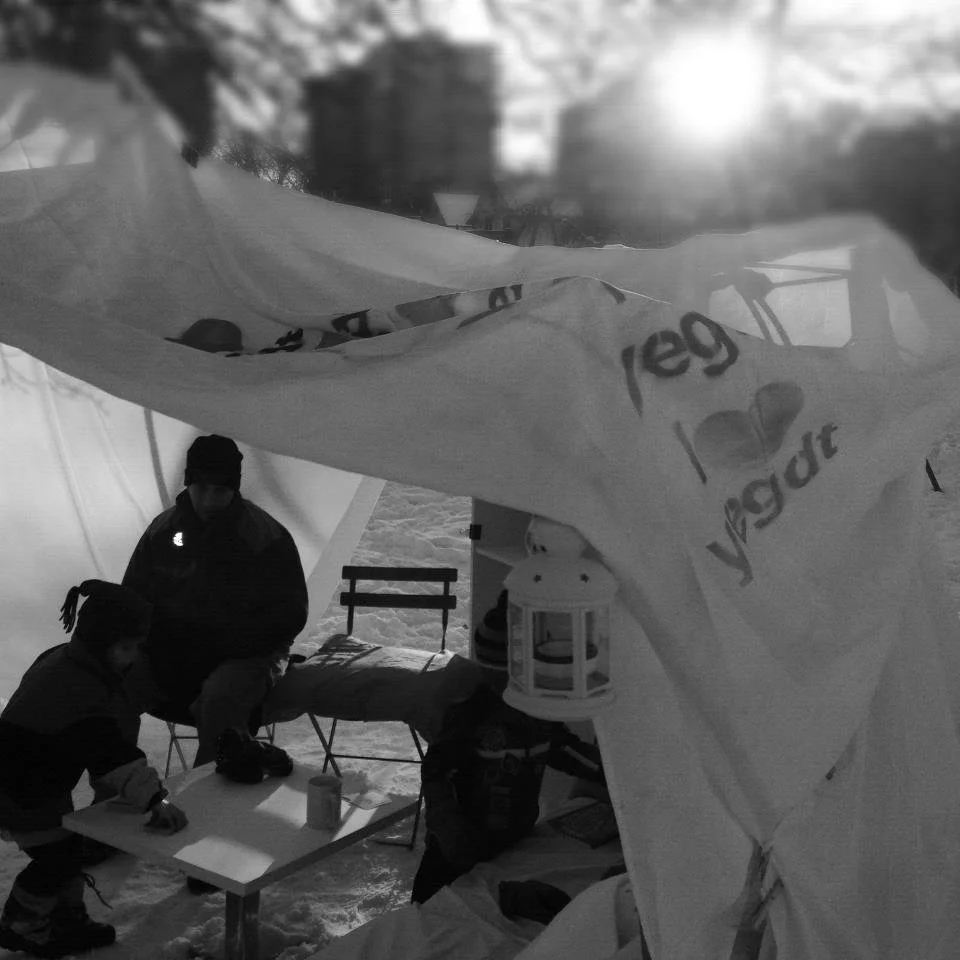
ComFORT at Kitchener Park.
There were practical lessons too:
Wind has opinions; design with it.
Materials should be forgiving; make it easy to succeed.
Scale matters; keep the first move small.
Snacks are strategy.
Hospitality is infrastructure.
Even the most tactical activations need stewards: people who can hold space, read the room, and know when to step back so the city can step in.
The deeper learning, however, was about power. ComFORT taught us that belonging grows where people can act on a place without asking permission from a distant gatekeeper. A sidewalk can become a living room if we design for participation, not performance. When the tools of shaping space are placed in many hands, people practice being citizens, not just consumers. That practice is a kind of liberation. It loosens the tightness that so often stifles public life. It says, “you matter here - your hands, your ideas, your time.”
Looking back today, ComFORT feels like a seed for the practice we continue to cultivate. It affirmed our belief that small is not the opposite of significant. Small is how significance begins. It clarified our commitment to community-led processes: collaboration over control, care over spectacle, joy as a form of intelligence. And it revealed that winter, the constraint we were warned about, was actually a collaborator. The season shaped behaviours (short bursts of making, then huddles of resting), encouraged cozy geometries, and made the offer of a warm drink feel like design. In a winter city, placemaking is not about fighting the cold; it’s about composing with it.
We also learned to measure differently. Instead of counting only heads or posts or press, we paid attention to dwell time, to the density of smiles, to the number of spontaneous “what if…” volleys exchanged. We noticed the progression of roles - from onlooker to helper, helper to leader, leader back to onlooker - because the work was lightweight and the stakes were shared. We saw that children are often our best urbanists: they intuit how to negotiate space, how to make room, how to declare a corner ‘cozy,’ and then defend that coziness with more cushions.
There were tender moments. A senior rested a little longer, watching people bustle by: “it feels like the city is saying hello.” A newcomer to Edmonton shared how the fort reminded them of home: the way neighbours would sit in doorways at dusk, chatting across the threshold.
“Build your fort; build your city,” was never just a slogan. It was a theory of change. ComFORT suggested that cities become loveable when they make room for small acts of making together: acts that are playful, yes, but also deeply social, quietly political, and entirely possible with modest means. The $500 was a constraint that sharpened our ethics: spend on care, choose materials that invite many hands, design a script that leaves room for improvisation.

If we ran ComFORT today, we’d do many of the same things, and we’d listen even more. We’d gather stores with intentionality, brings translators and elders and youth leaders into the co-steward role, and fold those narratives back into policy conversations about downtown design and winter-city standards. We’d treat each pop-up as a living document, adapting to the microclimate of a block, the rhythms of a workday, the culture of a neighbourhood. Because the point was never the fort. The point was the people - the way a simple structure can cue us to see one another again.
In 2012, we learned that architecture can be humble. We learned that play builds trust, trust builds courage, and that courage builds cities worth loving. ComFORT was a small thing. It was also, in its way, a beginning.
View the full project here.
Ready to co-create design as rest where you live? Let’s chat.